

As someone who has worked with multiple companies, I often get asked about the different types of my engagements which of course are really common. Let me share my perspective on how these roles differ and why fractional leadership can be particularly valuable for B2B SaaS companies.
In the early stages of a company, the primary focus is often on product development and finding the initial market fit. It’s an exhilarating time, filled with innovation and rapid iterations. But, as the company begins to grow, the challenges shift. It’s no longer just about having a great product; it’s about scaling that product in a sustainable and efficient manner. This is where growth leadership comes into play.
Growth leaders are tasked with navigating these turbulent waters of scaling up. They need to identify new market opportunities, optimize marketing strategies, and build scalable sales processes – all while keeping the burn rate in check and ensuring customer satisfaction. It’s a role that demands a unique blend of strategic vision and operational skill.
Nonetheless, not all companies need or can afford a full-time growth leader from the get-go. This is particularly true for B2B SaaS companies where resources can be tight, and the path to profitability might be longer than in other sectors. That’s where fractional leadership proves to be a game-changer.
What is Fractional Leadership?
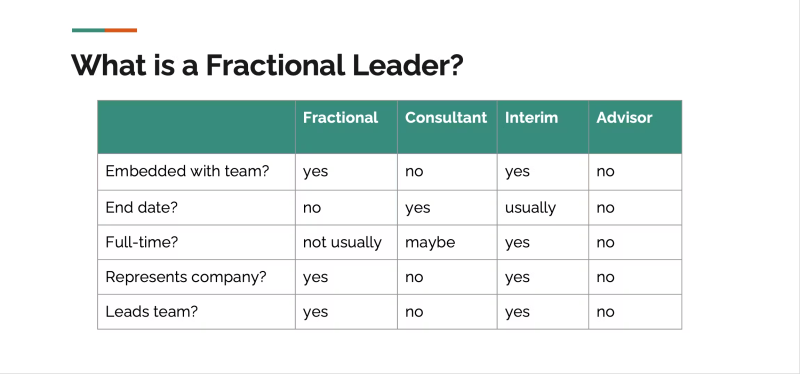
Fractional leadership allows a company to leverage experienced growth strategies without committing to a full-time salary. This model is especially effective in B2B SaaS environments where capital must be meticulously managed and the right skills at the right time can significantly alter the trajectory of the business. A fractional leader works part-time or on a project basis, injecting critical expertise just when it’s needed most. The fractional reader usually is tightly integrated with the team and is considered part of it. The are also – and depending the case / engagement – hands-on and with a GTD mentality.
In contrast, consulting roles are often more diagnostic and prescriptive in nature. Consultants come into a business to solve specific problems or address specific challenges. They analyze data, provide recommendations, and may help with implementation. However, their engagement is generally shorter-term and less hands-on than that of interim or fractional leaders.
Interim roles, on the other hand, fill temporary gaps in leadership. An interim growth leader might step in during a period of transition, such as between the departure of a previous leader and the hiring of a new one. They manage day-to-day operations, maintain momentum in strategic projects, and ensure stability until a permanent leader can be onboarded.
This diagram from the Fractionals Unitided community that I also belong will be helpful.
Choosing the Right Engagement Model
The decision between engaging a fractional, consulting, or interim growth leader depends largely on the specific needs and circumstances of the company. Each model offers its own set of benefits and is suited to different stages of a company’s lifecycle.
For startups and smaller B2B SaaS companies that are focusing on growth but need to manage cash flow carefully, fractional leadership can offer the strategic oversight and experienced guidance needed without the financial burden of a full-time executive. This allows these companies to remain agile and responsive to market changes while still driving aggressive growth agendas.
Consulting might be more suitable for companies facing very specific challenges that require deep expertise in particular areas—such as entering a new market or overhauling an underperforming sales department. In such cases, a consultant could provide the necessary insights and frameworks, setting the path for success and leaving once their goals have been achieved and their strategies implemented.
On the other side, interim leadership might be the best option for companies undergoing significant organizational changes or facing unexpected challenges that require immediate and knowledgeable leadership. This could include sudden market shifts, the need for crisis management, or simply bridging a key leadership gap as mentioned earlier. Interim leaders bring not only expertise but also stability to the company during these crucial times.
The Fractional Advantage
In my fractional growth leadership roles, I become a fully integrated part of the team, just like a full-time leader would – but with flexible time commitment. This allows me to bring the same level of strategic oversight and hands-on guidance that a full-time growth leader would provide, while giving companies the flexibility they need.
Why Choose Fractional Over Consulting or Interim?
While consulting projects have their place (and I occasionally take on specific consulting engagements), fractional leadership offers several unique benefits:
- Long-term strategic alignment: As a fractional leader, I’m invested in the company’s long-term success, not just specific project outcomes
- Team integration: I work directly with your team, helping build capabilities and processes
- Flexibility: Companies can scale my involvement up or down based on their needs
- Cost-effectiveness: Access to experienced leadership without the full-time executive cost
What’s next?
Answer these questions:
- Do you need experienced growth leadership but aren’t ready for a full-time executive?
- Are you looking to implement product-led growth strategies?
- Are you scaling or picking the marketing levers up?
Lets’ chat…
 George Psistakis | Fractional Growth | Marketing