
Please raise your hand if you’ve ever found yourself in a boring status meeting.
As daily standup meetings become more regular in agile development teams (but not only), it is critical that they are quick and productive.
A manager with a task list at hand checks the general progress. All participants (usually in turn) will give a status update and then the deliberations begin: 5 minutes talking, 15 minutes talking, 30 minutes talking and the list goes on. In general, after 15 minutes, the average person’s mind starts wandering.
Agile, on the other hand, has the famous “Daily Standup Meeting,” also known as the “Daily Scrum.
Even if you already use scrum, have you been experiencing challenges with your daily scrum — or are you simply looking to try a new approach? Then read on…
What is daily standup meeting in Scrum?

Well, a Daily Standup meeting is one of the most popular scrum event ceremonies and it is exactly what the word suggests: A daily meeting where everybody is literally standing! Of course, it involves much more than that.
A daily stand-up meeting, according to the Agile Alliance, is a critical practice in agile methodology that involves team members providing quick updates on their work progress, goals, and any roadblocks they’re encountering. These daily check-ins promote team cooperation, communication, and openness, as well as keeping everyone on track with the project’s goals and priorities.
Although you may find a lot of definitions on scrum meetings, the one I like best comes from an older book of James Shore & Shane Warden (The Art of Agile Development):
“… At a pre-set time every day, the whole team stands in a circle. One at a time, each person briefly describes new information that the team should know…”
What is the purpose of a daily standup meeting?
My favorite quote is from Gitlab: Daily stand-up meetings are for bonding, blockers and the future! A Daily Standup is more of a daily coordination rather than a status meeting. We solve problems together, act fast and save time.
For a more official explanation, a daily stand-up is:
…a time-boxed event for the team to synchronize activities and create a plan for the next 24 hours. This is done by inspecting the work since the last meeting and forecasting the work that could be done before the next one. (Ref.)
A successful daily standup meeting offers significant value to teams.
Atlassian suggests limiting daily stand-up meetings to 15 minutes, having everyone stand to keep the meeting focused and engaged, and concentrating on three important questions: What did you do yesterday, what are you planning to do today, and is there anything blocking your progress?
The Scrum Alliance adds that by adopting best practices, daily stand-up meetings may lead to considerable increases in team productivity and efficiency, as well as assist identify and address issues early in the development process.
According to a Trello research, teams who have daily stand-up meetings may save meeting time by up to 34% and are 1.4 times as likely to finish projects on schedule.
That makes it quite popular among many development teams in agile and quickly moving environments.
Criticism
While daily standup meetings are popular among development teams in agile environments, they are not without their criticisms. One of the most common criticisms is that they are a waste of time.
Some of these comments are valid and I think it is good to keep them in the back of our minds.
- Daily Standups interrupt the day. Especially if they are held in the morning. There are members that will wait for the stand-up to end in order to begin work.
- Daily Standups reduce productivity because they’re a context switch. Everybody on the team has to stop what they are doing to attend. Still, this is the case for practically everything that takes place in a working environment.
- People delay necessary communication until the next standup. Try not to drop team communication in favor of the daily meeting. Talk to someone when you have to.
- There is a guy that talks all the time. The solution is quite simple. You may set a maximum time limit, so everyone will have its share.
- Being brief has its own issues. Repeated reports of “nothing new” or “nothing to report” may, in fact, be indicating that something else is happening to the person or the team. This is where some elaboration has to take place.
- E.T.A. (Estimated Time of Arrival). Some people will turn in for work during or even after the meeting. Just start the meeting. If I were late I would feel bad the next time.
- I do not like to stand up. Yes me neither!
Setting Up a daily standup meeting
The most common setup is:
- A pre-set time every day. Daily Scrums only require fixed time and place (Could be a meeting room . Which time and place are up to the team to decide. It is an opportunity to inspect and adapt, a meeting in which the team plans their day.
- Keep a time-box of 15 minutes. The purpose of the standup is to give an idea of where the team is. So 15 minutes is OK. Smaller teams may even need less than that.
- Standing up. It helps to keep the meeting short, but Daily Scrum does not oblige you to do it standing up.
- Every member of the team “answers” three questions: What did I do yesterday? What am I doing today? What blocking issues I have that I need help from the team?
- If detailed discussions come up (or to adapt, or replan, the rest of the Sprint’s work) , it is a good practice to take them offline immediately after the meeting.
What does the standup meeting agenda look like?
The answer varies but every team member answers three questions. The goal of these daily standup questions is to provide transparency in the development team and engage its members in helping toward the sprint goal.
The three questions for your scrum meeting agenda are :
- What did I do yesterday?
- What am I doing today?
- What blocking issues I have that I need help from the team?
If detailed discussions come up (or to adapt, or re-plan, the rest of the Sprint’s work), it is a good practice to take them offline immediately after the daily scrum. Your scrum master should be able to recognize this and act on it so you can focus the attention to the problem and not the process.
For example, the technology business Asana has a daily standup meeting to ensure that everyone is on the same page and that any concerns are handled as soon as possible. At Asana’s daily standup meeting, team members provide updates on what they did the day before, what they intend to work on the next day, and any challenges they are experiencing.
Spotify is another example of a successful application of daily standup meetings. Teams at Spotify attend daily standup meetings to review what they did the day before, what they intend to focus on the next day, and any problems they are experiencing. Spotify, on the other hand, encourages teams to add creative activities, such as team-building exercises or games, into its regular standup meetings in order to keep the sessions exciting.
How I have seen played out in practice
From my experience in my company, and other companies that I worked for and consulted, we had is as a means of daily sync.
We used it as dev and team sync in my startup or daily sync with marketing teams.
How it played out is the following:
- We set a time where everyone can be present (or remote). For context if lets say we “started” working at 9:00AM we had it around 10 or 10:30AM.
- We try to keep it 15 minutes of timeboxed duration. And yes sometime we went over this.
- We don’t stand up when meeting in person.
- Usually we have one facilitator. For example me as a team lead was taking turns over our boards where the “teams” and persons speak.
- We keep our Kanban board in Asana or Trello close so we have a view of the tasks we are talking about.
- We keep our updates in the form of What I did, what I plan to do, what is blocking me. The blockers where always the most important.
- We took any follow-up conversations after the meeting. There where always some!
Facilitating daily standup meetings as a team leader is a crucial aspect of team management.
Make an effort to respect people’ time and make meetings brief, but don’t be concerned if they last longer than intended.
A team leader who calls a meeting but does not engage gives the message that he or she is uninterested in learning about the perspectives of others.
Daily Standup Tools and automating Dailies
Recently a few Slack daily stand up app appeared. The most prominent one is called Geekbot.
Geekbot is an app for asynchronous standup meetings inside Slack. Yep Slack… We are trying it for some time now. Although it cannot replace actual face to face time, it is a great tool for development team members that are not always in sync for their standup or they are in different time zones.
Give it a try (they are cool ppl too).
If you are looking for more have a look in this list of Daily Standup Tools for Slack.
How do I run a successful standup meeting?
If you are a team leader, facilitating daily standup meetings is an important part of running a team. Here are some tips and best practices that I always keep in mind to make this successful as possible.
- Respect the time of others!
- Holding these meetings at a set time every day is best. Don’t worry if you have to change it a few times; a habit will form eventually.
- It should be short, but don’t worry if it runs longer than you expected. If discussions fall off track, gently pull people back and focus.
- A team leader who holds a meeting and doesn’t participate sends a signal that he or she isn’t interested in understanding the opinions of others.
Other stand up meeting ideas
A lot of people and companies try to optimize their process and plan better ways to have a daily stand-up meeting.
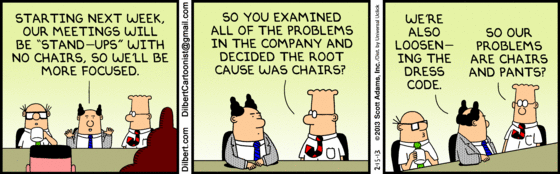
Here are some tips and best practices on how to run a stand up meeting and have every team member participate:
- Daily Stand up meetings over email
- The Treehouse way with their internal tool
- Ways to play Scrum from Gunther Verheyen
- The remote manifesto by Gitlab
Interesting Links
- Daily Scrum: http://www.scrumguides.org/scrum-guide.html#events-daily
- http://www.mountaingoatsoftware.com/agile/scrum/daily-scrum
- It’s Not Just Standing Up by Martin Fowler
- https://www.agilealliance.org/glossary/daily-meeting/
- https://www.atlassian.com/agile/scrum/standups
Conclusion: Do you do daily standups?
Make sure the Daily Scrum is worth of your time. Think of it as the catalyst to facilitate the work that the development team is doing. Do you have Daily Standups? Do you think they worth the trouble?
———
F.A.Q.
What’s the origin of the daily standup meeting?
The daily standup meeting was born as a result of Jeff Sutherland and other practitioners investigating high-performing engineering organizations in order to see how they worked. It seems that one of the most common ways to organize a team’s workflow is with daily standup meetings.
The original idea for this meeting came from an engineering team who had a high success rate with their projects. As Jeff writes, they took the idea and every day, the team gets together for a quick meeting to check in on how things are going. This is how the daily standup started.
What is the difference between a daily standup and a daily scrum?
Many teams use the meetings interchangeably. For example marketing teams will probably call it daily standup instead of daily scrum.
A daily scrum meeting is really a quick meeting meant only for the development team, led by the Scrum master. At this meeting, you’ll talk about tasks and problems to be dealt with during the day.
A standup meeting includes some of the same components as a daily scrum meeting, but it may include more people––including stakeholders.
 George Psistakis | Fractional Growth | Marketing